
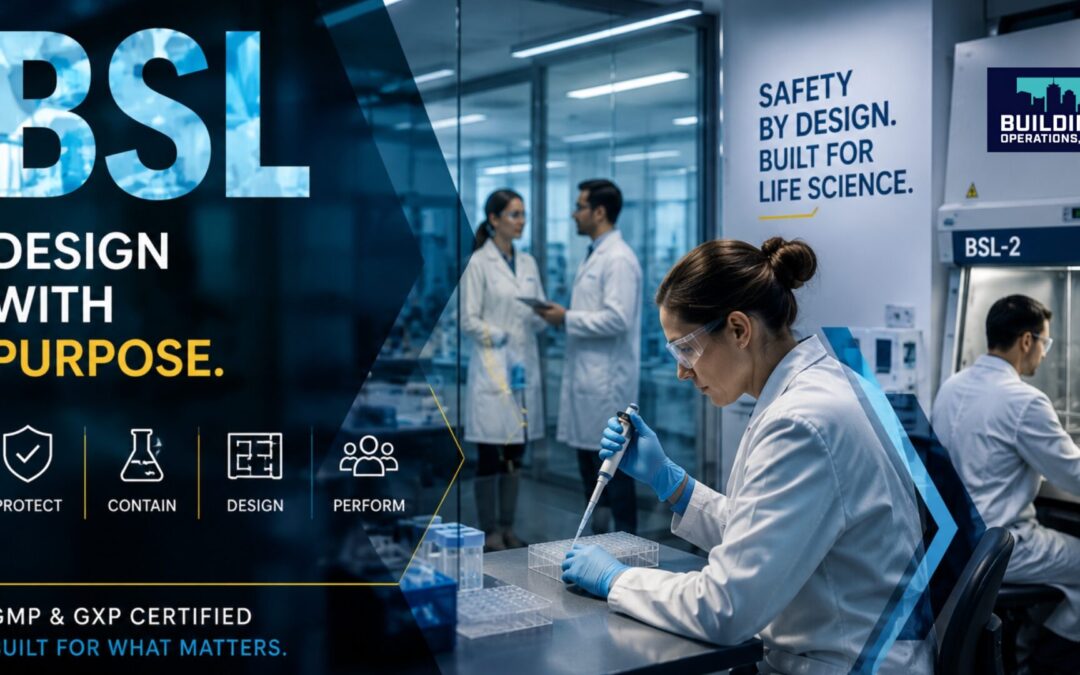
When people hear the term biosafety level, they often think of a scientific classification system used inside research environments. That is true, but in practice, biosafety levels influence much more than laboratory protocol. They shape how a space is planned, what systems it requires, how people move through it, and how it needs to be maintained over time.
For owners, developers, and operators involved in BioMed or life science facilities, biosafety levels are not just a technical detail. They have direct implications for design, infrastructure, compliance, and long-term operations. A lab’s biosafety requirements can affect airflow strategy, access control, spatial separation, finishes, waste handling, equipment coordination, and documentation standards from the very beginning of the project.
That is why biosafety planning should not be treated as something to figure out later. The earlier these requirements are understood, the better positioned a team is to create a lab environment that is safe, functional, and aligned with the work it is meant to support.
What biosafety levels are and why they matter
Biosafety levels, often abbreviated as BSL, are a framework used to define the containment precautions needed when working with biological materials. Their purpose is to protect lab personnel, the surrounding environment, and the integrity of the work being performed.
In simple terms, the higher the biosafety level, the greater the level of containment, control, and operational discipline required. These levels are not arbitrary. They are based on the risks associated with the biological agents in use, the procedures being performed, and the likelihood of exposure or transmission.
From a facility standpoint, that matters because the biosafety level affects more than signage or PPE requirements. It can determine whether a space needs directional airflow, separated access, specialized exhaust, controlled entry, dedicated support rooms, or stricter environmental controls. In other words, biosafety requirements do not sit on top of the facility. They shape it.
How biosafety levels are defined
Biosafety levels are defined by the combination of organism risk, laboratory procedures, containment requirements, and operational controls needed to safely support the work. That includes questions like:
- What type of biological agents will be handled?
- How severe is the potential risk to personnel or the environment?
- How easily can the material be transmitted?
- What engineering controls and operating procedures are needed to reduce exposure?
This is why BSL decisions should never be based on assumption alone. The level of containment required needs to reflect the actual nature of the work taking place in the lab.
For project teams, that means BSL is not just a scientific classification. It becomes a planning input. Once the containment level is understood, the implications for space design, airflow, access, support infrastructure, and operational procedures become much clearer.
What changes from BSL-1 to BSL-4
The progression from BSL-1 through BSL-4 represents increasing levels of containment, control, and facility complexity.
- BSL-1 environments typically support work involving agents not known to consistently cause disease in healthy adults. These labs generally require standard microbiological practices and basic facility features.
- BSL-2 introduces a higher level of precaution. This level often includes more formal access control, enhanced PPE requirements, biosafety cabinets for certain procedures, and stricter handling protocols for materials that present moderate risk.
- BSL-3 environments require a more robust containment strategy. That can include controlled access, directional airflow, tighter separation from adjacent spaces, and facility systems designed to reduce the risk of airborne exposure. At this level, infrastructure decisions become significantly more specialized.
- BSL-4 is the highest level of containment and involves extremely stringent controls, highly specialized systems, and a facility environment specifically designed for maximum isolation and protection.
For most owners and developers, the practical takeaway is not memorizing each category in detail. It is recognizing that each step up in biosafety level brings meaningful consequences for how the lab must be designed, built, and operated.
How BSL affects facility design decisions
Once a biosafety level is identified, it begins to influence some of the most important facility decisions in the project. One of the biggest is airflow and ventilation. Depending on the level of containment required, the lab may need specific air change strategies, pressure relationships, or exhaust approaches that support safe operation. These are not details to retrofit easily later.
Another is space planning and access control. Some lab environments require clearer separation between clean and potentially contaminated areas, more controlled points of entry, or layouts that support more disciplined movement of people, materials, and waste.
Surfaces, finishes, and cleanability also matter. In regulated or biosafety-sensitive spaces, durable and easily cleanable materials are not just a maintenance preference. They support the day-to-day integrity of the environment.
Utilities and equipment coordination are another major factor. Certain biosafety-sensitive environments may require infrastructure that supports specialized equipment, cabinet placement, decontamination procedures, or uninterrupted environmental performance.
The important point is this: BSL is not just about the activities happening at the bench. It affects the systems, flow, and physical logic of the entire environment.
Which biosafety level does your lab need?
This is one of the most important questions in early planning, and it is not one that should be answered casually. The right biosafety level depends on the type of research or testing being performed, the materials being handled, the procedures involved, and the risk profile of the work. It also depends on the broader context of the facility. A lab’s operational model, staffing, equipment, compliance expectations, and long-term use all influence how the environment should be planned.
For that reason, determining the right BSL is not just a technical exercise for the scientific team. It is also a facility planning decision. If the required containment level is misunderstood or defined too late, the result can be expensive redesign, infrastructure limitations, operational inefficiency, or compliance complications down the road.
The earlier this conversation happens, the easier it becomes to align design intent with actual facility needs.
Why early coordination matters
In BioMed projects, some of the most expensive problems come from late clarity. A team moves forward with a general lab concept, only to realize later that the biosafety requirements call for different airflow, different room relationships, different access controls, or different operational support than originally planned.
That kind of late-stage adjustment can affect budget, schedule, procurement, permitting, and occupancy readiness all at once.
Early coordination helps prevent that. When biosafety requirements are understood early, teams can make more informed decisions around:
- infrastructure capacity
- ventilation and controls
- room configuration
- equipment planning
- maintenance access
- compliance documentation
- vendor coordination and turnover planning
It also creates a stronger bridge between design, construction, and operations. The result is not just a more compliant space. It is a more functional one.
Where Building Operations comes in
Building Operations helps owners and developers translate specialized lab requirements into practical facility planning and real-world execution. In BioMed and life science environments, that means helping teams think through how space, infrastructure, systems, and operations need to work together from the start.
From early planning and project coordination to regulated-environment support and operational readiness, we help create lab spaces that are aligned with both technical requirements and day-to-day performance. That includes supporting environments where safety, compliance, and long-term serviceability all need to be considered together, not separately.
Our GMP and GXP-certified background also strengthens our ability to support teams working in regulated, high-performance settings where documentation, consistency, and operational discipline matter.
If you are planning a BioMed or life science space and need to think through biosafety requirements early, Building Operations can help guide the conversation toward a lab environment that is safer, smarter, and better prepared to perform over time. Learn more here: https://www.buildingoperationsmafl.com/bio-med-and-life-science/