
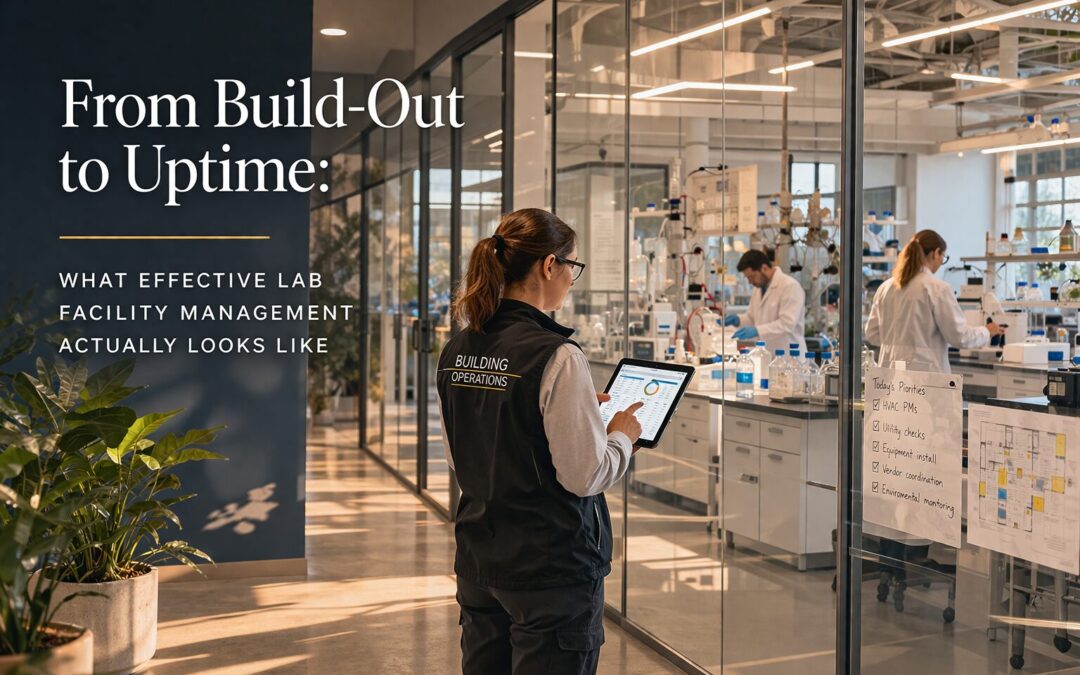
When a lab project reaches substantial completion, it can feel like the hard part is over. In reality, that is when a different kind of work begins. Once the space is occupied, success depends less on construction milestones and more on how reliably the environment performs every day.
In life science and BioMed settings, facility management is not just about keeping the lights on. It is about protecting uptime, maintaining the right environmental conditions, supporting critical equipment, coordinating vendors, and making sure the space continues to operate the way it was intended to.
That is why stabilization matters. A lab may be newly built, but it is not truly successful until systems, people, and operations are working together consistently. Here is what effective lab facility management actually looks like after move-in.
Why stabilization is a real phase, not an afterthought
There is a tendency to think of occupancy as the finish line. In practice, it is more like a transition point. The lab has been delivered, but the day-to-day operating rhythm is still being established. Teams are testing workflows, equipment is being calibrated, vendors are getting into their service cycles, and facilities teams are learning how the space behaves under real use.
Without a thoughtful stabilization period, small issues can quickly turn into larger operational problems. An airflow imbalance, a delayed maintenance handoff, or a missing equipment protocol may not seem significant on day one, but over time those gaps can affect safety, performance, scheduling, and user confidence.
A strong stabilization phase helps close the gap between design intent and operational reality. It gives owners and operators the opportunity to confirm that building systems are performing as expected, vendors are aligned, documentation is complete, and users are set up for a smoother start.
Base-building systems that matter most in labs
Lab environments place a very different level of demand on core building systems than standard office space. HVAC, electrical, plumbing, exhaust, controls, and backup systems all play a much more active role in supporting daily operations.
Effective facility management starts with knowing which systems are most critical to the specific type of lab and how they interact with the work happening inside the suite. That typically includes:
- HVAC and pressurization control: Maintaining stable air changes, pressure relationships, temperature, and humidity so the space supports both compliance requirements and consistent research conditions.
- Electrical reliability: Supporting sensitive instruments, backup power needs, and the distribution required for specialized equipment and critical operations.
- Plumbing and specialty utilities: Managing domestic water, lab gases, process connections, drainage, and any utility systems tied directly to equipment function.
- Controls and monitoring: Tracking alarms, setpoints, and system performance so issues can be identified early instead of after disruption occurs.
- When these systems are actively monitored and well understood, facility teams can respond faster, plan better, and avoid unnecessary interruptions.
Preventive vs. predictive maintenance
Preventive maintenance remains the foundation of strong facility management. It gives teams a defined schedule for inspections, servicing, and upkeep before issues become failures. In lab environments, that discipline is essential because many systems cannot simply be allowed to fail and then repaired later.
At the same time, more teams are moving beyond calendar-based maintenance alone. Predictive maintenance adds another layer by using performance data, trends, and condition monitoring to spot problems before they interrupt operations. That can be especially useful for equipment or infrastructure tied to environmental control, uptime, or high replacement cost.
The most effective programs usually do not treat preventive and predictive maintenance as competing approaches. They use both. Preventive maintenance creates consistency, while predictive maintenance helps teams become more targeted and proactive with the assets that matter most.
Managing critical equipment and vendors
In a lab setting, equipment management is closely tied to facility performance. New equipment may require utility adjustments, service clearances, environmental review, delivery coordination, or vendor involvement long before it is operational. The same is true for removals, replacements, and reconfigurations.
That is why vendor coordination should be treated as an operational function, not just an administrative task. Strong facility management means knowing who is responsible for what, when service is scheduled, what access is required, and how work will affect adjacent operations.
For many teams, the real challenge is not a lack of vendors. It is the lack of coordination between them. Base-building contractors, specialty service providers, equipment manufacturers, and internal stakeholders all need to work from the same playbook. When that coordination is missing, downtime grows, communication gets messy, and even routine work becomes disruptive.
A more structured approach helps ensure equipment additions and removals happen cleanly, maintenance windows are planned, and service activity supports the lab instead of interrupting it.
What data to track for smarter repair and replacement decisions
Not every asset should be managed the same way. Some systems are mission critical, some are simply high-maintenance, and others become expensive because issues are repeated without being fully addressed. Good facility management depends on knowing the difference.
A useful reporting framework often includes:
- Downtime history: How often a system or piece of equipment has interrupted operations, and for how long.
- Repair frequency and trend patterns: Whether a problem is isolated or becoming a recurring issue.
- Cost of service: What is being spent on repair, emergency response, and vendor support over time.
- Response and resolution timelines: How quickly issues are being identified, assigned, and resolved.
- Asset criticality: The operational impact if a system fails, including compliance risk, research disruption, and tenant experience.
When teams track this consistently, repair-versus-replace decisions become much clearer. Instead of reacting to the latest issue in isolation, they can make decisions based on performance history, business impact, and long-term value.
How better facility management supports compliance and tenant retention
In life science environments, good facility management supports much more than maintenance. It helps create the reliability that tenants, researchers, and operators depend on. Stable environmental conditions, documented maintenance activity, coordinated service work, and consistent system performance all contribute to a space that feels dependable and professionally run.
That matters for compliance, of course, but it also matters for relationships. Tenants notice when the lab environment is responsive, well maintained, and easy to work in. They also notice when service feels fragmented, disruptions are frequent, or operational issues take too long to resolve.
Over time, strong facility management can help protect tenant confidence, reduce avoidable friction, and support retention by making the building easier to operate and easier to trust.
Where Building Operations comes in
Building Operations helps owners and developers carry a lab project beyond delivery and into dependable day-to-day performance. From base-building oversight and environmental coordination to equipment planning, vendor management, preventive maintenance support, and post-construction readiness, we help teams move from build-out to real operational continuity.
If you are managing a BioMed or life science space, we would be glad to talk through how to support uptime, serviceability, and long-term performance from the moment the lab opens. Get to know more here.